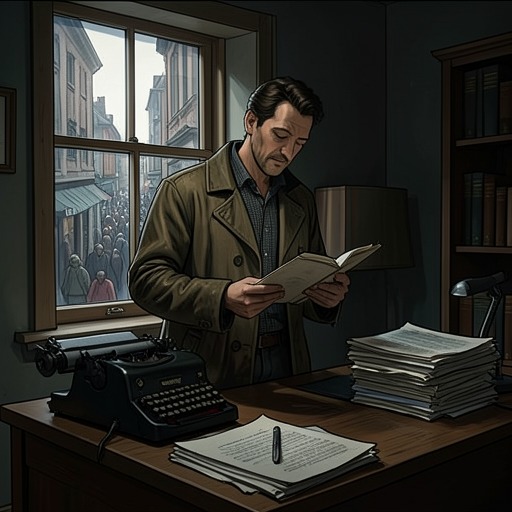
Martin adopts a hack-work strategy
Martin EdenMartin Eden adopts a hack-work strategy in an effort to make writing financially practical without abandoning his ambition to produce serious literature. He moves into a rented room, returns his manuscripts to editors, and proposes earning money from material he considers commercially useful but artistically lesser. The plan is both a change of method and a test of his relationship with Ruth Morse: Martin presents it as a route toward a secure future together, while Ruth measures it against the fact that his admired work has not brought in money.
Background and Immediate Decision
The proposal comes after a pause in Martin’s routine of strenuous work and writing for publication. He tells Ruth that he has spent the interval loving her, thinking, and reading, and that the rest has given him perspective on his own prospects. He has also been considering his place in the world and what it would take to reach a position he believes suitable for her. The resulting plan is not a retreat from writing, but an attempt to make it compatible with earning a living.
Martin has already taken practical steps before explaining what he means by work. Since boarding with his sister costs too much, he has rented a small room in North Oakland and bought an oil-burner for cooking. Ruth welcomes the domestic economy, especially the burner, and compares the arrangement to the way Mr. Butler began his career. Martin is inwardly displeased by that comparison, but continues with his account: he has put stamps on his manuscripts and sent them to editors again. He has moved into the room and says that the next day he will begin work.
Ruth initially understands this to mean that he has found a position. Her delight is immediate and physical: she nestles closer, presses his hand, and smiles as she asks what the job is. Martin then clarifies that the work will be his writing. Her face falls. The shift from hopeful welcome to visible disappointment makes clear that the disagreement is not simply over whether Martin will work, but over what kind of work can plausibly support their shared future.
The Commercial Plan
Martin describes his chosen market as Grub Street. Instead of waiting for editors to accept his more ambitious pieces, he intends to produce jokes, paragraphs, feature articles, humorous verse, and society verse. He also identifies newspaper syndicates, short-story syndicates, and Sunday-supplement syndicates as outlets for material in demand. He believes that steady production for these markets could bring him the equivalent of a good salary, while leaving him more time than an ordinary position would.
The proposal is explicitly economic. Martin contrasts freelance writers who can earn four or five hundred dollars a month with the low prospects he imagines for an unskilled worker in Oakland. He does not claim that he wants to become such a writer in every respect; he presents their earnings as evidence that writing can pay. His immediate aim, as he explains it, is a good living and control over some of his own time, not the abandonment of literary ambition.
He has already tried the smaller, quick-turnaround form of the plan. The night before speaking with Ruth, he wrote half a dozen jokes for comic weeklies. Before going to bed, he also wrote four humorous triolets in less than an hour, calculating that at a dollar each they might bring in four dollars. The example makes his proposed method tangible: income would come from repeatable pieces written quickly, rather than from waiting indefinitely for a major work to find a buyer.
Art, Study, and the Promise of Success
Martin’s distinction is between paid hack-work and what he regards as real work. Commercial assignments, he argues, could keep him in contact with literary life and provide time for study and for the preparation of masterpieces. He does not treat the lesser work as valuable in itself; he calls it dull and sordid. But he compares its drudgery favorably with keeping books for sixty dollars a month, adding columns of figures in a job he considers equally tedious and less suited to his aims.
His confidence is rooted in a story he tells about his own development as a writer. At first, he says, his experiences were only pictures: he lacked both the knowledge to interpret them and the words with which to think about them. As his knowledge and vocabulary grew, the experiences acquired meaning, and he believes this was when his writing improved. He names Adventure, Joy, The Pot, The Wine of Life, The Jostling Street, the Love-cycle, and the Sea Lyrics as work produced during that development. He expects to write better pieces in the future, but now proposes to do so in the time left over from paid assignments.
Martin also identifies reading Herbert Spencer’s Philosophy of Style as part of the reflection that changed his view of his own writing and of much magazine writing. The pause has therefore not meant intellectual inactivity: he has read, thought, and reassessed both his craft and his prospects. The strategy that follows is his attempt to combine that intellectual preparation with immediate earnings, rather than to choose between them.
Ruth’s Objection and Martin’s Bet
Ruth challenges the central assumption behind the plan. The larger works may matter deeply to Martin, she points out, but he has not sold them. In her view, the inability to sell the work he himself considers good is not an incidental delay: they cannot marry on masterpieces that bring in no money. Martin answers that they can marry on triolets that sell, but the confidence of the answer does not dissolve her disappointment.
When Ruth presses the point, Martin asks for two years. He insists that hack-work is only a makeshift and predicts that, within that period, editors will be glad to buy his serious work. He claims to know what literature is and to recognize the difference between his own aims and the average material published by lesser writers. His certainty is set against the record Ruth invokes: the manuscripts have gone out, but the work she considers good has not yet earned anything.
Martin rejects ordinary business employment as a poor alternative. He expects that he would never advance beyond a clerkship, dislikes what he regards as its dull, mercenary, and tricky character, and doubts that a clerk’s earnings could provide the life he wants for Ruth. He also imagines the income of a successful author in striking terms, estimating that a best-selling book might earn between fifty and a hundred thousand dollars, sometimes more or less. The contrast between the modest immediate returns of jokes and triolets and that hoped-for success reveals how much of his practical plan still rests on faith in a future breakthrough.
Significance
The episode marks Martin’s attempt to reconcile artistic vocation with financial necessity by dividing his labor into two tracks: commercial writing for present income and serious writing for future achievement. Its practical details—the rented room, the oil-burner, the stamped manuscripts, and the four proposed dollars from triolets—give material form to a plan that might otherwise remain an aspiration. Yet the conversation also shows why the plan cannot reassure Ruth: its immediate income is uncertain, while its promised reward depends on Martin’s confidence that editors will eventually recognize the work they have so far declined to buy. The strategy offers a new way to keep writing, but it leaves the couple’s central disagreement unresolved.